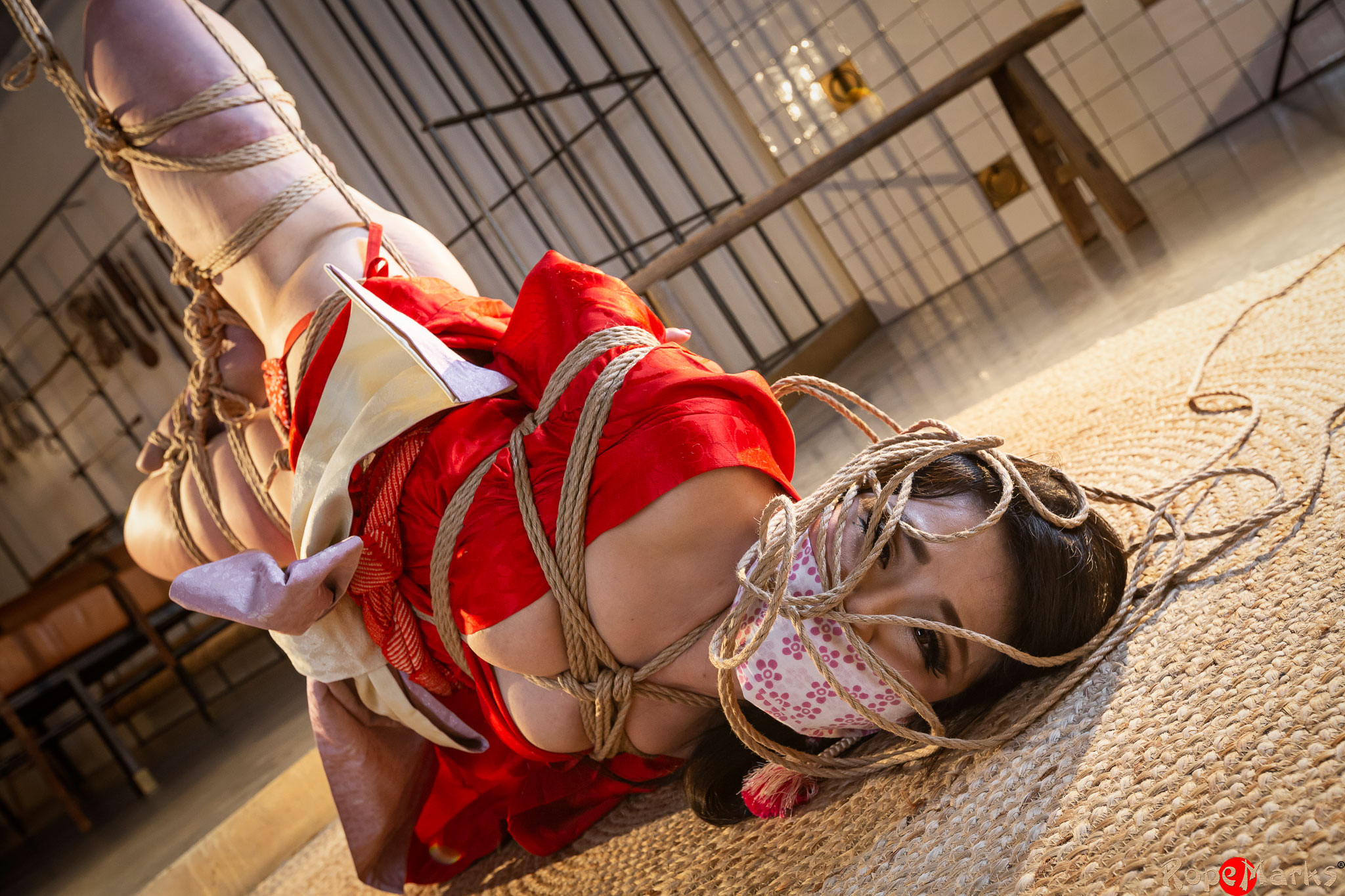

Translating a Japanese name without seeing the kanji is difficult.
For instance, "kata" means a lot of things and each has a
different kanji thus a different meaning.
So, a word of warning about this glossary is in order. A bondage does not have a
name! When a name is used for a specific bondage that "name" merely describes
what is going on. In shibari positions as in music there are many variations on a melody
or theme. Trying to name a bondage can be deceptive and different artists use different
terms and descriptions for what they create. This is often what causes confusion when
especially Westerners discuss shibari ties.
There are quite a few names and terms that have come down to us in a generally
useful way from history, from hojojutsu terminology and
from well known modern sensei and these have become fairly standard.
Naming a bondage becomes useful when you try to explain it, the name helps
smooth the communication. The definitions in this glossary are not written in
stone. There is unanimous agreement on most of these terms but a few represent
general agreement by most authorities.
Knowing the "correct" Japanese word for every shibari
tie doesn't make you a nawashi no more than owning an
expensive camera makes a great photographer. So, take the names in this glossary
with a grain of salt and focus on what kinbaku is all
about. It will definitly take you years of study before you start to feel in your
bones what kinbaku actually is all about!
- A
- B
- C
- D
- E
- F
- G
- H
- I
- J
- K
- L
- M
- N
- O
- P
- Q
- R
- S
- T
- U
- V
- W
- X
- Y
- Z
A
- agura shibari
-
Generalized term for any tie where the sub sits in a
crossed legged (Indian style) position. Although somewhat similar in
appearance, this tie should not be confused with the far more restrictive
ebi shibari.
- aomuke zuri
- Suspended face up
- aranawa
- rice rope
- asanawa
- Traditional Japanese style bondage rope made of hemp or jute.
Shibari rope is usually 7 meters in length and
between 6 to 8 mm in width. Usually a knot is tied at each end so that these
"buttons" can be used for certain wrapping style or
hojojutsu ties where no real knot is ever used to secure the tie because
the button holds the rope(s) in place. Various shibari
artists (nawashi) use different methods for treating
their ropes to increase their suppleness and longevity.
B
- bari
- Sometimes shibari is reduced to the shortened word "bari" as in "ebi-bari".
D
- dorei
- Slave, Servant; It has been put forth that rope captives are called "dorei", (denoting
slave) this is too strong of a term for most in Japan. "dorei" comes from a
Greek word to denote ancient eastern European slavery. Slave play in Japan
is actually really rare, and is to harsh a term for most "rope submissives" to be comfortable with.
E
- ebi shibari
-
The "shrimp" or
"prawn" tie. One of the oldest traditional kinbaku ties.
It was used as a
torture technique (ebizeme) for 100's of years and is referenced in many
manuals and art works.
- ebizeme
- Being bound by rope.
To be punished by being tied in the ebi ("shrimp"
or "prawn") tie was a form of torture that was mandated by the Tokugawa
shogunate in 1742 as one of 7 official punishments for criminals and enemies
of the state. Therefore, be advised, in the short term the
ebi shibari is a fun position for SM play but can
be quite an ordeal over time. Please play carefully.
G
- gyaku-ebi
A reverse ebi, very similar to the western hog-tie.
- gyaku-ebi zuri
- See gyaku-ebi, but now suspended from rope.
In this position both legs are suspended individually.
H
- hashira ushirodaki shibari
- Tying someone using a wooden (usually a bamboo) pole.
- hishi shibari
-
Taken from early hojojutsu techniques, this tie creates a
diamond shape.
- hojojutsu
- The ancient martial art of capturing/arresting with rope.
- hon kikkou
-
Tortoise shell, this tie creates a hexagonal shape.
J
- Joshu
- Also written as "Joshuu", means "female prisoner"
K
- karada
-
Body; A generalized term for any of a variety of body harnesses / rope dress.
- kata-ashi zuri shibari
- one leg suspended,
any of a number of styles of one leg up suspensions.
- kikkou shibari
-
The famous tortoise shell tie so called because the pattern created resembles that found
on the Japanese tortoise. This can be full body or only torso. There are several styles of kikkou shibari taught. The traditional style
creates one or more hexagonal shapes on the bound subject. A second style,
popularized in manga illustrations, creates at least three linked diamond
(hishi) shapes running from the neck to the pubic area.
- kinbaku
- To bind tightly;
The art of traditional Japanese bondage.
- kinbaku-bi
- Usually translated as "the beauty of
traditional shibari art." That is, shibari done
in the traditional manner for an aesthetic / erotic effect.
M
- m zuri
- Suspended from the takate kote with the thighs in front
- m-jo
- This is the most widely accepted term in Japan today for
the one captured in rope. Some just refer to themselves as a "model" -
Most rope captives think of themselves simply as "models".
Emu is Japanese pronumciation of Roman letter "M" as in short for "Masochist".
Jo is like young woman.
- m-o
- Male m-jo
- maete shibari
- A tie in front of the body.
see also: ryo-tekubi shibari
- matanawa
-
Generalized term for any pubic area tie or "crotch rope."
- Mune nawa
-
Breast/Chest bondage
- Momo
- thigh, peach. Momo shibari is a form of tying the thighs so the sub is forced
to kneel with the head low to the floor and the buttocks raised so they resemble
a peach.
N
- nawashi
- A maker of rope; "Rope artist"; A person that has reached a certain degree of proficiency in
handling nawa, if you are called Nawashi in Japan you are
considered doing good, solid rope work. Expectations/standards for that in Japan are quite high not just "play" rope.
R
- ryo-tekubi shibari
-
Both wrists tied together. It does not matter where the wrists are, or if the tie is
cinched, as long as the wrists are tied together.
- ryo-ashi zuri
- Suspending your model with both legs together, i.e. binding both ankles together.
S
- sakasa zuri
- Inverted suspension, the m-jo is hanging head down and the body
vertical, not supported by a tsuri nawa on the takate kote.
(when pronouncing stress the first SA)
- sakuranbo
- Cherry; Used by some into Oriental bondage to refer to
"tying up the cherry" (a euphemism for tying up the female bottom in such a
way that emphasizes the cherry/ vagina area).
- santen zuri
- Suspended from the takate kote with the ankles in front. Sort of sitting position.
San means three, this refers to the number of suspension lines.
Another word for santen zuri is M zuri because the body and the knees up form the letter M.
- sensei
- Teacher, Master, Doctor; he who has gone before.
- shibararetai
- A sub indicating his/her desire for bondage action.
- shibari
- Fabric weaving; Tying ("things"); The action of tying someone up; Since the
evolution of shibari from tying techniques used solely for restraint and
torture to sophisticated erotica has taken 100's of years to mature, it's
natural that, for Westerners especially, the terminology can get a bit
confusing. The word "shibari" to most non SM oriented Japanese simply means
weaving!;
- shibaritai
- A top indicating his/her desire for bondage action.
- shibari Sensei
- A term invented in the western world to describe a Oriental rope master/artist.
- shinju
- Pearl; Shinju is used to refer euphemistically to the nipple.
T
- tanuki (tsuri)
- Suspended inverted (face down) from all four limbs.
(You can't do the tanuki without suspension, so you don't need to mention tsuri)
- teppo shibari
-
Named for the Japanese flintlock rifle, the Teppo.
- tomei nawa
-
The safety rope between arms and chest; the cinch.
- tsuri
- Any rope suspension.
The second classic torture technique (tsurizeme) from
Tokugawa Japan, now evolved into a mainstay of shibari play
and performance.
becomes "zuri" when preceded by another word
- tsuri nawa
- Suspension rope
- tsurizeme
- Being bound and suspended by rope.
U
- ushirode shibari
- A tie on the back of the body.
see also: ryo-tekubi shibari
- ushirode-gassho shibari
- A tie usual referred to in English as the "reverse prayer
tie." This tie is only for the limber! There are Buddhist and Western
variations.
- ushiro takatekote shibari
-
The basic box arm tie, the building block of most
shibari
ties. There are many variations of this from the simple to the complex.
- ushiro tasuki shibari
-
The ushiro tasuki shibari is a hojojitsu inspired bondage. In this pattern the hands are
tied in a "W" position on the back and an "X" shape is created between the breast.
Y
- yoko zuri
- Sideway suspension
A final word on spelling, for years I've seen the "capturing martial art" spelled, hojojitsu both
on western sites dedicated to martial arts and, more importantly, on several translations of Japanese sources.
This seemed correct as it was similar to jiu-jitsu. More recently, hojojutsu seems to have become more common.
Which is what we will use on R.A.R.E. Thanks to Osada Steve for pointing this out and Master "K" for
an elaborate explanation.